While checking out our group’s video on YouTube, I came across this video entitled Engineer’s Paradise. If the title reminds you of the rap song "Gangsta’s Paradise", it is likely because this video is based on that song. I found it to be completely hilarious watching this old engineer from IBM rap about engineering. It has over 100,000 views and it seems that other people have created additional versions with captions in Italian, Dutch, etc. I know many of you are still working on your YouTube videos, so I hope that this video can give you a few laughs as you put the final touches on your videos.
Saturday, December 11, 2010

Small study looking at our cohort
Purpose:
To understand the similar experiences of our cohort that lead to potential overlap across their habitus' (or disposition).
Research Question:
What are the shared experiences of our cohort? In what ways (if any) might these shared experiences be indicative of overlap across habitus?
Methodology:
Developed survey based on the Inez research paper we read and discussed in two of our classes.
Distributed the survey as a paper instrument and collected it anonymously.
Analyzed the data and write up results for this blog.
Results & Conclusions:
There was strong family support for college education but students had much weaker college advising on average (Q1, Q4).
½ of cohort answered that they worked during their undergraduate years. While this is at best a proximate measure of socioeconomic status, the fact that so many held a job could indicate that this half of the cohort were less likely to be from a high socioeconomic status. (Q7)
College statistics on major and department changing suggest that the rate of major or department change in our cohort is normal. (Q 13, Q 17, Q18)
Reaching the level of a PhD degree is not equivalent to entering college or vocational school; more effort must be made and recognizable skills must be demonstrated to be accepted. Some of the experiences of our cohort, particularly poor advising and potentially lower socioeconomic status or at least financial hardship during college years work as barriers to college success. Their appears to also be a considerable amount of social support for educational pursuits, from the family, which could facilitate success. These two experiences seem to be at play for many of the members of our cohort and may effect their habitus and their subsequent entry into PhD studies here. More variables may be behind these circumstances, but from the variables we have identified it appears that the barriers were not as resilient as the facilitators for success.
This research is meaningful because it sheds some light on what type of students this department has attracted. It offers an opportunity for some reflexivity and further studying may afford deeper insight into the shared experiences of students attracted to and accepted into this field (in the academic and Bourdieuian sense).
Limits of Research:
Small sample size, non randomized sampling. Both undercut ability to conduct statistical analysis.
Next Steps
Consider Qualitative Study in the Spring
Considering writing paper for a conference
Consider expanding to all ENE grad students
References:
DiMaggio, Paul. (1979). Review: On Pierre Bourdieu. The American Journal of Sociology. 84(6) 1460-1474.
Foor, C.E., Walden S.E. & Trytten D.A. (2007). “I Wish That I Belonged More in this Whole Engineering Group:” Achieving Individual Diversity. Journal of Engineering Education. 103-115
Data: The Responses people could give were:
*Really not like my experiences at all* 1
*Not usually what I experienced* 2
*Sometimes occurred or fits my experience* 3
*Often occurred and a pretty good experience fit* 4
*Very close fit to my experiences* 5
*Not able to answer* 6
Graphs:


Youtube Challenges
We have had number of challenges when making our Youtube video. We had multiple cameras filming us at different angles, and at the end we wanted to integrate them. After the initial recording we realized one of the cameras did not capture the sound, at all. Another camera, we realized, the sound was so low that we could barely hear us speaking. For this reason we had to record multiple times. During the editing process we tried best to make the sound consistent throughout the film. During the editing process, we also realized that the sound and the image separated whenever we tried to trim the video. Later we realized we had to convert the .mts file to .wmv or .avi file before making any trimming process. Another difficult part was to shrink our time to 10 minutes. When we were done, the recording was over 14 minutes. We realized that even taking out 5 to 7 seconds to trim the duration to 10 minutes was very hard, just because we wanted to have it in there.
Anyway with all that said, I am really excited with what we have. We plan to have our final meeting this afternoon, and I am really looking forward to sharing the video with the rest of the class on Monday. It has taken long hour to compile but seeing the final product (almost), it’s worth it. I hope that our video carries the message that we intended to do.
We have also had many help from Michelle (letting us use her house), James (the camera operator) and Rene (setting) and many others. We couldn’t have done it without their help.
Friday, December 10, 2010
The Dangers of Confusing Engineering with Science

Illustration: Harry Campbell.
From IEEE Spectrum article "Engineering is not Science."
I'd like to quickly highlight an article that brings us back to a seemingly timeless question: what exactly is an engineer? Henry Petroski, a professor of engineering and history at Duke University, writes about the importance of distinguishing scientists and engineers in this month's IEEE Spectrum. (note: IEEE stands for the Institute of Electrical and Electronics Engineers and is a non-profit professional association. Spectrum is their monthly magazine.)
In the article, Mr. Petroski argues two key points:
- Engi
 neering and science are distinct fields. "Science is about understanding the origins, nature, and behavior of the universe and all it contains; engineering is about solving problems by rearranging the stuff of the world to make new things."
 - The United States government should increase funding for engineering fields. "Scientists might argue that the government needs to invest in basic scientific research that will lead to unspecified discoveries about energy, water, and waste. Although a good deal is already known about those things, it certainly would not hurt to know more, but what would really move things forward would be investments in engineering."
This underfunding and confusion between the fields leads to a dangerous impact: "...it can leave politicians,policymakers, and the general public unable to make informed decisions about the technical challenges facing the world today."
While I agree that it is important to make the distinction between the fields, I was bothered by the article's implication that science and scientists are "higher ranking" than engineering. Upon reflection, that public perception is probably true -- how many times when news broadcasts have discussed solving world issues has a scientist been brought in as the expert vs. an engineer? (Another question to consider is how many times has that technical expert been a woman -- but that's an issue for another post.)

If you take the time to read the article, be sure to check out the comments section. Being engineers, most of the commenters are quick to agree with the "We are definitely NOT scientists! HMPH!" sentiment. Something that struck me, however, was a quip that was being copied over and over again: Engineers learn to build. Scientists build to learn. Really? Engineers = builders? Is anyone else conjuring up images of the children's television show Bob the Builder? I can understand trying to come up with a succinct statement to remember how to differentiate the two fields -- hey, it worked for 'i' before 'e' except after 'c' or the sound of 'a' as in "neighbor" and "weigh". Even if we agree with the statement, then a new question arises -- how are we different from designers? Yikes. We recognize that engineering is a complex intersection of math, science, designing, and a multitude of other fields. I don't think it's wrong to state that fact openly -- we should give the American public more credit for being able to understand fields aren't always black and white.
As a final note, the article highlights the issues that arise when engineering and science are not properly distinguished. However, it fails to mention any solutions for how we can promote engineering and emphasize its differences from science. How do you think this can be accomplished? I'd love to hear your responses in the comments!
Thursday, December 9, 2010
Software for help?
Robin just got back from a visit to Tufts, and learned about this awesome stop-action movie software:
http://www.samanimation.com/
Check it out in case it is helpful for your youtube videos. :-)
http://www.samanimation.com/
Check it out in case it is helpful for your youtube videos. :-)
Confessions
In the conversation Angela, Lorie, and I had last week regarding suggested changes/improvements in engineering education, I made an attempt to describe a relationship between ENE and academia. I said that if we wanted to change ENE, there might be a need for a change in academia as a prerequisite. If we want to change the shape of ENE (say circle peg), and want it to fit into academia (say square hole), then we have to make the square hole large enough to encapsulate the circle or we lose some of the circle as it gets trimmed into the square hole. Essentially that is what I believe happens now whether we intend to or not. I suggested, though ambitious, that it might be necessary to create an alternative to the academy but recognized that it would require the equivalent respect/resources/status or we would be duplicate some behaviors that got us to where we are now. I don't have disdain for the academy per se, but I think trying to mold ourselves as engineers and ENE into something means we generated an identity from pictures of others. I know we need a guide when we don't know what we look like and want to project an image, but I felt like the need to be recognized by academia kind of distracted us because we wanted status and prestige and respect. Personally, I am willing to forgo that status and attached respect because I'm not so concerned about image (or so I think). Because of that I'm okay with challenging the shape of the square hole or creating a completely new shape for ENE to coexist with academia so it does not have to fit into it. Have we done enough and grown enough to be big enough to walk on our own as a field and can we educate in a responsible novel fashion freely? Then I was politely reminded by my YouTube partner that I could afford to do that because I already have the stamp of approval as I graduated from the top ACADEMY in my field, so I carry credibility and respect and need to defend less than some others. I hadn't considered it really because I don't want around with it stamped on my face, but it is very much true. I'm in reflective mode a week later and still don't know what to do with it. So I give it to you.
The Engineer of 2020 and Purdue
I thought that some people would be interested in seeing Purdue's thoughts on the Engineer of 2020. https://engineering.purdue.edu/Engr/Academics/Engineer2020/

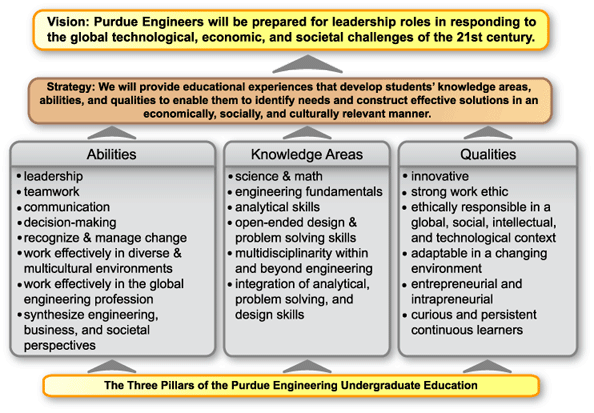
The 20 attributes are listed under three headings: abilities, knowledge areas, and qualities. I was trying to separate the Engineer of 2020 skills into the two areas of epistemology and ontology. It seems that I can probably group the items under the knowledge areas heading with epistemology. Also, many of the items under abilities can probably be grouped under ontology. However, the qualities heading seems to be a mixture of both. Furthermore, they are more like desired outcomes (or what we hope for-the ideal engineer) than the qualities of every engineer. Please let me know your thoughts.
The 20 attributes are listed under three headings: abilities, knowledge areas, and qualities. I was trying to separate the Engineer of 2020 skills into the two areas of epistemology and ontology. It seems that I can probably group the items under the knowledge areas heading with epistemology. Also, many of the items under abilities can probably be grouped under ontology. However, the qualities heading seems to be a mixture of both. Furthermore, they are more like desired outcomes (or what we hope for-the ideal engineer) than the qualities of every engineer. Please let me know your thoughts.
Subscribe to:
Posts (Atom)