Showing posts with label Natalie. Show all posts

Monday, December 13, 2010

Epistemology vs Ontology

Dall' Alba brings up a problem when the educational program focuses exclusively on epistemology that they miss out on the “being” of the profession (2009). Students educated this way may have the skills and knowledge, but may not know how to apply them in practice. On the other side, knowing ontology without epistemology can also be a downfall. Dall' Alba poses how an architect can graduate “without knowing how to locate a building on a designated site?” Ontology without epistemology, would suggest that although the architect knows how to locate a building, they do not know how to construct an architectural plan. So, it does appear that both types of knowledge are important and that there are downfalls if the student is only seeing one item. This paradox of rigor versus relevance that Schon speaks of is a tension that Palmer believes that we need to be comfortable with to manage and provide a good foundation for students (2000; Schon, 2000).

Dall’Alba, G. (2009). Learning Professional Ways of Being. Learning to be Professionals, 111-132.

Palmer, P., & Neuenschwander, D. (2000). The courage to teach: Exploring the inner landscape of a teacher’s life. American Journal of Physics, 68, 93.

Schon, D. (2000). The new scholarship requires a new epistemology. Learning from change: landmarks in teaching and learning in higher education from Change magazine, 1969-1999, 32.

Saturday, December 11, 2010

An Engineering Rap YouTube video

While checking out our group’s video on YouTube, I came across this video entitled Engineer’s Paradise. If the title reminds you of the rap song "Gangsta’s Paradise", it is likely because this video is based on that song. I found it to be completely hilarious watching this old engineer from IBM rap about engineering. It has over 100,000 views and it seems that other people have created additional versions with captions in Italian, Dutch, etc. I know many of you are still working on your YouTube videos, so I hope that this video can give you a few laughs as you put the final touches on your videos.

http://www.youtube.com/watch?v=Y0DxmthvkKU

Thursday, December 9, 2010

The Engineer of 2020 and Purdue

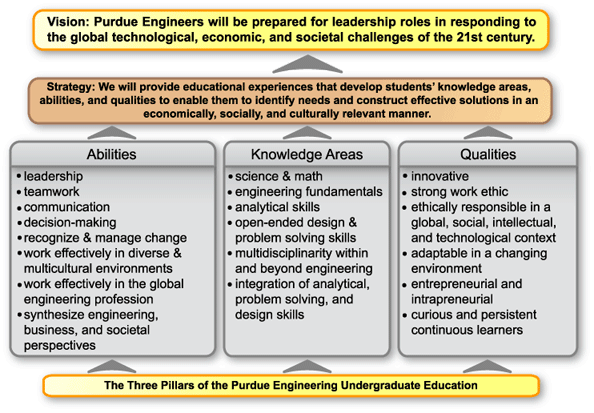
I thought that some people would be interested in seeing Purdue's thoughts on the Engineer of 2020. https://engineering.purdue.edu/Engr/Academics/Engineer2020/


The 20 attributes are listed under three headings: abilities, knowledge areas, and qualities. I was trying to separate the Engineer of 2020 skills into the two areas of epistemology and ontology. It seems that I can probably group the items under the knowledge areas heading with epistemology. Also, many of the items under abilities can probably be grouped under ontology. However, the qualities heading seems to be a mixture of both. Furthermore, they are more like desired outcomes (or what we hope for-the ideal engineer) than the qualities of every engineer. Please let me know your thoughts.

Friday, December 3, 2010

My thoughts on the Engineering Education Wikipedia page construction

Although I thought that writing a Wikipedia page about engineering education research was commendable, doing so in an hour was quite a formidable task. There was a bit of silence at the beginning as we (I know this was true for me) tried to recover from the bomb that was just dropped on us. After the silence came a few ideas about the content, then there were a few ideas about the process. In no time, a Google Doc was created and many of us went to the front computer to input our e-mail addresses so that we could all make changes to the collective document. Then, there was a flurry of typing in different portions of the document as each person/group inputted information that they deemed necessary for the page. Some people were inputting lists while others were pasting the links that were relevant to the items of the list. I personally entered a few of the research areas as well as the corresponding short descriptions. Although we had a fair amount of material, it was not in any kind of orderly format. It was just a bunch of randomly placed ideas. This caused a new set of people to emerge and volunteer to get the ideas in order. The new task for most of the group was to figure out what the major sections of the page would be and to decide what material corresponds to each section. An implication of assigning material to a section was the material that was not selected for a section did not make it to the Wikipedia page. There were no votes or extensive speeches to try to get unassigned material onto the page as many may not have realized that the assignment process caused some material to be left behind. Once a few of the sections were formed (and maybe even before), there were people trying to get the material organized on the Google Doc and inserted onto the Wikipedia page. At the end of this exercise, we (as a class) had created a Wikipedia page about engineering education research. Looking back on this experience, I can see that it was boundary work. We were trying to carve out a space for engineering education research. Some of the things that I wonder about as I reflect on this boundary work are: What piece of the story is missing due to the unassigned material? What piece of the story is missing in general? Who is included by the boundary that we have created? Who is not included? How representative is the resulting Wikipedia page to each person’s personal thoughts of engineering education research? Or to the class’ collective thoughts of engineering education research?

Wednesday, November 17, 2010

Interesting YouTube Video

While searching for a diversity article for Seminar two weeks ago, I came across a name of someone who is regarded as an expert in diversity education in engineering that I decided to Google. When I found his biographical information, I realized that this person has had a large, yet indirect, impact on my life. He is a founder of the fellowship that I received for my master’s degree in engineering. I watched a YouTube video interview that I found about him and I was surprised to see that he also considers mentoring his hobby. I was going to paste the link in the Seminar Blackboard discussion forum when I realized why I even want to share this video in the first place. During week 11, we discussed Slayton’s book chapter,” Opportunity in the City”, which showed a case of unsuccessful minority inclusion in higher education. One person even commented in class that the efforts were a complete failure. I want to share this YouTube video to illustrate some minority inclusion efforts that have been successful. Dr. Howard Adam’s efforts have not only been successful for me, but for the other fellowship recipients and his mentees (which include the current CEO of Xerox, Ursula Burns). I hope that you enjoy the video!

http://www.youtube.com/watch?v=95cq1ll-jbQ