While checking out our group’s video on YouTube, I came across this video entitled Engineer’s Paradise. If the title reminds you of the rap song "Gangsta’s Paradise", it is likely because this video is based on that song. I found it to be completely hilarious watching this old engineer from IBM rap about engineering. It has over 100,000 views and it seems that other people have created additional versions with captions in Italian, Dutch, etc. I know many of you are still working on your YouTube videos, so I hope that this video can give you a few laughs as you put the final touches on your videos.
Saturday, December 11, 2010

Small study looking at our cohort
Purpose:
To understand the similar experiences of our cohort that lead to potential overlap across their habitus' (or disposition).
Research Question:
What are the shared experiences of our cohort? In what ways (if any) might these shared experiences be indicative of overlap across habitus?
Methodology:
Developed survey based on the Inez research paper we read and discussed in two of our classes.
Distributed the survey as a paper instrument and collected it anonymously.
Analyzed the data and write up results for this blog.
Results & Conclusions:
There was strong family support for college education but students had much weaker college advising on average (Q1, Q4).
½ of cohort answered that they worked during their undergraduate years. While this is at best a proximate measure of socioeconomic status, the fact that so many held a job could indicate that this half of the cohort were less likely to be from a high socioeconomic status. (Q7)
College statistics on major and department changing suggest that the rate of major or department change in our cohort is normal. (Q 13, Q 17, Q18)
Reaching the level of a PhD degree is not equivalent to entering college or vocational school; more effort must be made and recognizable skills must be demonstrated to be accepted. Some of the experiences of our cohort, particularly poor advising and potentially lower socioeconomic status or at least financial hardship during college years work as barriers to college success. Their appears to also be a considerable amount of social support for educational pursuits, from the family, which could facilitate success. These two experiences seem to be at play for many of the members of our cohort and may effect their habitus and their subsequent entry into PhD studies here. More variables may be behind these circumstances, but from the variables we have identified it appears that the barriers were not as resilient as the facilitators for success.
This research is meaningful because it sheds some light on what type of students this department has attracted. It offers an opportunity for some reflexivity and further studying may afford deeper insight into the shared experiences of students attracted to and accepted into this field (in the academic and Bourdieuian sense).
Limits of Research:
Small sample size, non randomized sampling. Both undercut ability to conduct statistical analysis.
Next Steps
Consider Qualitative Study in the Spring
Considering writing paper for a conference
Consider expanding to all ENE grad students
References:
DiMaggio, Paul. (1979). Review: On Pierre Bourdieu. The American Journal of Sociology. 84(6) 1460-1474.
Foor, C.E., Walden S.E. & Trytten D.A. (2007). “I Wish That I Belonged More in this Whole Engineering Group:” Achieving Individual Diversity. Journal of Engineering Education. 103-115
Data: The Responses people could give were:
*Really not like my experiences at all* 1
*Not usually what I experienced* 2
*Sometimes occurred or fits my experience* 3
*Often occurred and a pretty good experience fit* 4
*Very close fit to my experiences* 5
*Not able to answer* 6
Graphs:


Youtube Challenges
We have had number of challenges when making our Youtube video. We had multiple cameras filming us at different angles, and at the end we wanted to integrate them. After the initial recording we realized one of the cameras did not capture the sound, at all. Another camera, we realized, the sound was so low that we could barely hear us speaking. For this reason we had to record multiple times. During the editing process we tried best to make the sound consistent throughout the film. During the editing process, we also realized that the sound and the image separated whenever we tried to trim the video. Later we realized we had to convert the .mts file to .wmv or .avi file before making any trimming process. Another difficult part was to shrink our time to 10 minutes. When we were done, the recording was over 14 minutes. We realized that even taking out 5 to 7 seconds to trim the duration to 10 minutes was very hard, just because we wanted to have it in there.
Anyway with all that said, I am really excited with what we have. We plan to have our final meeting this afternoon, and I am really looking forward to sharing the video with the rest of the class on Monday. It has taken long hour to compile but seeing the final product (almost), it’s worth it. I hope that our video carries the message that we intended to do.
We have also had many help from Michelle (letting us use her house), James (the camera operator) and Rene (setting) and many others. We couldn’t have done it without their help.
Friday, December 10, 2010
The Dangers of Confusing Engineering with Science

Illustration: Harry Campbell.
From IEEE Spectrum article "Engineering is not Science."
I'd like to quickly highlight an article that brings us back to a seemingly timeless question: what exactly is an engineer? Henry Petroski, a professor of engineering and history at Duke University, writes about the importance of distinguishing scientists and engineers in this month's IEEE Spectrum. (note: IEEE stands for the Institute of Electrical and Electronics Engineers and is a non-profit professional association. Spectrum is their monthly magazine.)
In the article, Mr. Petroski argues two key points:
- Engi
 neering and science are distinct fields. "Science is about understanding the origins, nature, and behavior of the universe and all it contains; engineering is about solving problems by rearranging the stuff of the world to make new things."
 - The United States government should increase funding for engineering fields. "Scientists might argue that the government needs to invest in basic scientific research that will lead to unspecified discoveries about energy, water, and waste. Although a good deal is already known about those things, it certainly would not hurt to know more, but what would really move things forward would be investments in engineering."
This underfunding and confusion between the fields leads to a dangerous impact: "...it can leave politicians,policymakers, and the general public unable to make informed decisions about the technical challenges facing the world today."
While I agree that it is important to make the distinction between the fields, I was bothered by the article's implication that science and scientists are "higher ranking" than engineering. Upon reflection, that public perception is probably true -- how many times when news broadcasts have discussed solving world issues has a scientist been brought in as the expert vs. an engineer? (Another question to consider is how many times has that technical expert been a woman -- but that's an issue for another post.)

If you take the time to read the article, be sure to check out the comments section. Being engineers, most of the commenters are quick to agree with the "We are definitely NOT scientists! HMPH!" sentiment. Something that struck me, however, was a quip that was being copied over and over again: Engineers learn to build. Scientists build to learn. Really? Engineers = builders? Is anyone else conjuring up images of the children's television show Bob the Builder? I can understand trying to come up with a succinct statement to remember how to differentiate the two fields -- hey, it worked for 'i' before 'e' except after 'c' or the sound of 'a' as in "neighbor" and "weigh". Even if we agree with the statement, then a new question arises -- how are we different from designers? Yikes. We recognize that engineering is a complex intersection of math, science, designing, and a multitude of other fields. I don't think it's wrong to state that fact openly -- we should give the American public more credit for being able to understand fields aren't always black and white.
As a final note, the article highlights the issues that arise when engineering and science are not properly distinguished. However, it fails to mention any solutions for how we can promote engineering and emphasize its differences from science. How do you think this can be accomplished? I'd love to hear your responses in the comments!
Thursday, December 9, 2010
Software for help?
Robin just got back from a visit to Tufts, and learned about this awesome stop-action movie software:
http://www.samanimation.com/
Check it out in case it is helpful for your youtube videos. :-)
http://www.samanimation.com/
Check it out in case it is helpful for your youtube videos. :-)
Confessions
In the conversation Angela, Lorie, and I had last week regarding suggested changes/improvements in engineering education, I made an attempt to describe a relationship between ENE and academia. I said that if we wanted to change ENE, there might be a need for a change in academia as a prerequisite. If we want to change the shape of ENE (say circle peg), and want it to fit into academia (say square hole), then we have to make the square hole large enough to encapsulate the circle or we lose some of the circle as it gets trimmed into the square hole. Essentially that is what I believe happens now whether we intend to or not. I suggested, though ambitious, that it might be necessary to create an alternative to the academy but recognized that it would require the equivalent respect/resources/status or we would be duplicate some behaviors that got us to where we are now. I don't have disdain for the academy per se, but I think trying to mold ourselves as engineers and ENE into something means we generated an identity from pictures of others. I know we need a guide when we don't know what we look like and want to project an image, but I felt like the need to be recognized by academia kind of distracted us because we wanted status and prestige and respect. Personally, I am willing to forgo that status and attached respect because I'm not so concerned about image (or so I think). Because of that I'm okay with challenging the shape of the square hole or creating a completely new shape for ENE to coexist with academia so it does not have to fit into it. Have we done enough and grown enough to be big enough to walk on our own as a field and can we educate in a responsible novel fashion freely? Then I was politely reminded by my YouTube partner that I could afford to do that because I already have the stamp of approval as I graduated from the top ACADEMY in my field, so I carry credibility and respect and need to defend less than some others. I hadn't considered it really because I don't want around with it stamped on my face, but it is very much true. I'm in reflective mode a week later and still don't know what to do with it. So I give it to you.
The Engineer of 2020 and Purdue
I thought that some people would be interested in seeing Purdue's thoughts on the Engineer of 2020. https://engineering.purdue.edu/Engr/Academics/Engineer2020/

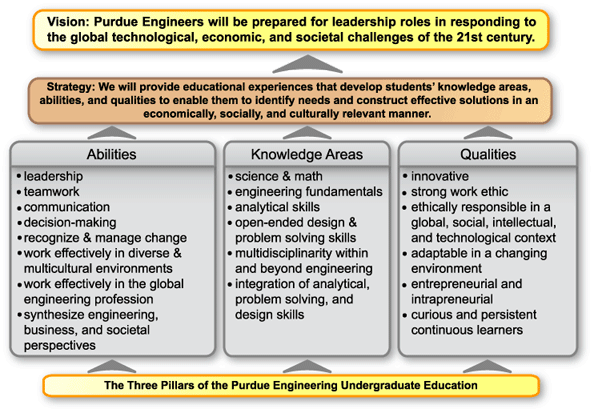
The 20 attributes are listed under three headings: abilities, knowledge areas, and qualities. I was trying to separate the Engineer of 2020 skills into the two areas of epistemology and ontology. It seems that I can probably group the items under the knowledge areas heading with epistemology. Also, many of the items under abilities can probably be grouped under ontology. However, the qualities heading seems to be a mixture of both. Furthermore, they are more like desired outcomes (or what we hope for-the ideal engineer) than the qualities of every engineer. Please let me know your thoughts.
The 20 attributes are listed under three headings: abilities, knowledge areas, and qualities. I was trying to separate the Engineer of 2020 skills into the two areas of epistemology and ontology. It seems that I can probably group the items under the knowledge areas heading with epistemology. Also, many of the items under abilities can probably be grouped under ontology. However, the qualities heading seems to be a mixture of both. Furthermore, they are more like desired outcomes (or what we hope for-the ideal engineer) than the qualities of every engineer. Please let me know your thoughts.
Monday, December 6, 2010
The boundary work of Los Andes University, Bogotá-Colombia
Los Andes is the University were I used to workback in my country. Is a very new university (it has 62 years) and was "the first non confessional private university in Colombia, independent from all political parties."*
I think is interesting the parallel with Purdue because both have a very strong engineering school. Actually, I have bee
n thinking a lot in this parallel and how can it be connected to the boundary work we have been doing in this class... So I came up with the following micro-research about the themes Los Andes' engineering school published in its own magazine, during the last eleven years.
Here are the numbers...

The upper part of the charts shows the chapters used in the magazine to classify the articles. The lower part of the chart shows the classification I made based on the titles, abstracts, and sometimes based on a skim of the article if the theme wasn’t yet clear. I know that this second classification is biased by my experience and knowledge, but I found some interesting things during this almost twenty years of publication.

First of all is interesting how the names of the chapters change along the years. At the very beginning, when there was only one issue per year, the magazine had two parts: Research, and Research summaries. Both addressed the technical themes; although the second one took into account some boundary and education articles. Then, a third chapter came out: Opinion. In that last classification felt all the few education articles in that time. Some other parts of the magazine came, such as information, memory, or in memoriam; but what I found more interesting is how they changed the name of the first part to Engineering instead of Research. But how other themes such as engineering education can’t be research? Or engineering?

Looking at the most popular themes, the articles into the chapters called Engineering or Research, are almost the same as the ones I classified as technical articles. Adding boundary articles to technical ones, is more alike the engineering/research chapters’ amount of articles. Although in the first years, and in the middle years (magazines 10-13) this similarity decreases.
Another interesting thing I saw is that Engineering Education articles are sometimes classified as Engineer, and some other times as Opinion. I can say that during these years, engineering education is on the boundary of what the School of Engineering at Los Andes consider as part of Engineering discipline. I found it very interesting, because I can see it from the inside.
I also can notice the importance that the School of Engineering gave to engineering education from 2003 and especially during 2004 (magazine 20), which was a couple years after the curriculum changed, and few years before the construction of the new engineering building.
… So this is another “boundary work” about engineering.
free video camera and editting help at Hicks Undergraduate library
Class
After Ben found this place I went to the Hicks undergraduate library to get a 2nd video camera on Friday, reserved for 3 days. They said in the lab in the subbasement that they are open and usually staffed 7x24 to help with Windows Moviemaker this week. They were not sure if they will always staff 2-600am. There are Sony video cameras at Hicks available with a purdue ID to use for free for 1-3 days.I am at Hicks now at 10:43pm and it like downtown Chicago at Rush Hour. But there is staff to help with Windows Moviemaker, conversion of tapes and any MovieMaker editing problems that you have. They are really customer friendly.You have to go to Hicks to reserve cameras. you can reserve video conversion machines at http://www.dlc.purdue.edu/
click on reserve a compeuter
search by device for miniDV deck if you are using tape was we were.
reserve a PC, stations 3,4,5,10
you need the same amount of conversion minutes as you have DV tape.
dan, Natalie, Ben
After Ben found this place I went to the Hicks undergraduate library to get a 2nd video camera on Friday, reserved for 3 days. They said in the lab in the subbasement that they are open and usually staffed 7x24 to help with Windows Moviemaker this week. They were not sure if they will always staff 2-600am. There are Sony video cameras at Hicks available with a purdue ID to use for free for 1-3 days.I am at Hicks now at 10:43pm and it like downtown Chicago at Rush Hour. But there is staff to help with Windows Moviemaker, conversion of tapes and any MovieMaker editing problems that you have. They are really customer friendly.You have to go to Hicks to reserve cameras. you can reserve video conversion machines at http://www.dlc.purdue.edu/
click on reserve a compeuter
search by device for miniDV deck if you are using tape was we were.
reserve a PC, stations 3,4,5,10
you need the same amount of conversion minutes as you have DV tape.
dan, Natalie, Ben
What is Engineering Education Concept Map

I feel like I am leaving A LOT of our readings out, but I think I can work with this story. I am essentially combining (and reorganizing) my two essays to first address what is engineering knowledge, then address how knowledge is acquired,then to how teaching is related to learning (I very much believe the two cannot be evaluated independently) and close with how my views on all of the above shape how I believe engineers should be educated. I welcome any comments!
This morning “Tomorrow’s Professor” Newsletter discussed a survey of the current status of graduate engineering distance education at leading US engineering schools. This is an issue near and dear to my heart as I commute 192 miles each way for classes. Since Purdue does offer distance learning courses for graduate engineering classes, I had hoped to be able to take advantage of these offerings. However, I soon discovered that this was not the case. The engineering distance learning classes that are offered through Purdue are not available to other engineering graduate students unless we wish to pay a significant premium for taking these courses. At this point, this is a significant barrier to me.
I will be very curious to see the results of this survey. I am curious to see if all of the programs are online programs only or if they are combination of distance and traditional brick and mortar classrooms. I believe that there are multiple ways to engage in meaningful learning situations. I am also curious to see if the distance programs offer similar or different degrees to that of the homeschool. Will an online degree have equal weight to the traditional degree? Are these schools using the online programs to generate cash for their home institutions or is the money going directly back into building the online program?
I have found that on-line learning environments have encouraged me to be more reflective. I have time to really think about my responses and engage in conversations at optimal times for me. In addition, e-learning is much more responsive to my needs as an adult learner.
I was so disappointed to discover that the Purdue engineering distance program would not allow me to enroll in their classes without a significant cost for each course. I hope that eventually, they will change their minds and see the advantage of making the classes available to all Purdue engineering students. By making the online classes inclusive rather the exclusive, I believe it will strengthen all of our experience. Working graduate students will gain exposure to people engaged in an academic research environment and vice versa. This is beneficial to all. I also believe it will still be beneficial to the bottom line…
Distance Education Offered by Leading U.S. Schools of Engineering. Addressing Change: A Survey (July 2010)
For a copy of the report go to www.croyassoc.net.
Engineering synthesis

I thought I would share some of how I organized the synthesis of the "what is engineering" readings. I am currently working on a similar diagram for the "what is engineering education" essay. I am having a difficult time bounding the work so it is manageable. Any thoughts?
a different kind of data, PhD comic strips!
In case you are stuck on your essays and papers this week, here is a link to an example of using PhD comic strips as examples of dicussion points. I make no representations as to its quality just to the uniqueness of the approach. When you are stuck, as I was stuck on an essay until i talked with Ruthie this morning, whatever works to get the juices flowing might be considered an option.
https://blackboard.purdue.edu/webct/urw/lc4614621886031.tp4708705173151/displayContentPage.dowebct?pageID=5346537813121&resetBreadcrumb=false&displayBCInsideFrame=true
This link goes to the Methods section of Inquiry in the folder for Narrrative Presentation, Methods presentation number 6, the file labeled Narrative research_comics .
In any case listening again to 106 yr old Ann Nixon Cooper, the living example of narrative research at Spellman College from our Narrative Research discussion, is a great treat on any day of the week.
Here is the Youtube link to Ann,
http://www.youtube.com/watch?v=95hAIlwyY78
Good writing and Youtubing this week.
dan
https://blackboard.purdue.edu/webct/urw/lc4614621886031.tp4708705173151/displayContentPage.dowebct?pageID=5346537813121&resetBreadcrumb=false&displayBCInsideFrame=true
This link goes to the Methods section of Inquiry in the folder for Narrrative Presentation, Methods presentation number 6, the file labeled Narrative research_comics .
In any case listening again to 106 yr old Ann Nixon Cooper, the living example of narrative research at Spellman College from our Narrative Research discussion, is a great treat on any day of the week.
Here is the Youtube link to Ann,
http://www.youtube.com/watch?v=95hAIlwyY78
Good writing and Youtubing this week.
dan
your first graduate student holiday joke-to lighten your mood for dead week
A man in Scotland calls his son at Cambridge in graduate school the day before Christmas Eve and says,
"I hate to ruin your day but I have to tell you that your mother and I are divorcing; forty-five years of misery is enough".
"Dad, what are you talking about?'" the son screams.
"We can't stand the sight of each other any longer", the father says. "We're sick of each other and I'm sick of talking about this, so you call your sister at the University of Edinburgh, and tell her".
Frantically, the son calls his sister, who explodes on the phone, "Like hell they're getting divorced", she shouts, "I'll take care of this".
She calls home immediately and screams at her father, "You are NOT getting divorced. Don't do a single thing until I get there. I'm calling my brother back and we'll both be there tomorrow. Until then, don't do a thing, DO YOU HEAR ME?"and hangs up.
The man hangs up his phone and turns to his wife.
"Done! They're coming for Christmas - and they're paying their own way."
happy graduate student holidays!
"I hate to ruin your day but I have to tell you that your mother and I are divorcing; forty-five years of misery is enough".
"Dad, what are you talking about?'" the son screams.
"We can't stand the sight of each other any longer", the father says. "We're sick of each other and I'm sick of talking about this, so you call your sister at the University of Edinburgh, and tell her".
Frantically, the son calls his sister, who explodes on the phone, "Like hell they're getting divorced", she shouts, "I'll take care of this".
She calls home immediately and screams at her father, "You are NOT getting divorced. Don't do a single thing until I get there. I'm calling my brother back and we'll both be there tomorrow. Until then, don't do a thing, DO YOU HEAR ME?"and hangs up.
The man hangs up his phone and turns to his wife.
"Done! They're coming for Christmas - and they're paying their own way."
happy graduate student holidays!
Sunday, December 5, 2010
Reflection Post: Dr. David Lubinski Seminar: Study of Mathematical Precious Youth (SMPY)
Last Thursday I was able to hear a seminar by Dr. David Lubinski. He is an American Psychologist at Vanderbilt University. I was very impressed by his presentation in terms of his research question and delivery of his "message" aka findings.
I will first summarize what his he presented and than give my reactions to the presentation.
Intro and overview:
The Study of Mathematical Precious Youth (SMPY) a longitudinal study of five cohorts that total about 5000 participants that were recruited from 1972 till-1997. These individuals were identified as high achievers around 13 years old based on their high mathematical achievements. They were in the top 1% of the mathematical reasoning ability and most were scoring at the max of SAT and IQ test at early ages. These students could learn at a faster rate and were different intellectual from the population of people that were outside of the 1% achievement standard.
The research question that he studied and discussed with us was, within these top 1% of achievers were their any differences both intellectually (mathematics, spatial and verbal abilities) and non intellectual attributes (interest and personality).
Findings (I do not recall this in details but invite others who attended to fill the gaps):
1. there was a consistent difference in that all had higher spatial ability that their verbal ability
2. The higher achievers in math tended to have even higher variation in their spatial abilities
There was a graph the he should to represent were STEM students were relative to the spatial ability and other variables (I'm not able to recall in detail). But I think STEM are more aware of objects and things than those in Humanity.
3. In terms of motivation the high achievers worked long hours were willing to work long hour hours than required. They were motivated by the work they preformed.
(Again for those there please add what you recalled, it would be nice to have the presentation emailed to us)
My reactions:
1. HUGE BOUNDARY WORK: In 1972 who was the population of people even prepared to take a test such as the SATs. And now that there is this boundary of 1% how does this help the other 99% of people who a the majority of people in society.
I enjoyed that the message of human capitol trumps the need for inclusiveness and generalizability. What do I mean by this? Well he mentioned also as part of the results that these 1% can be beneficial to society. According to his data these people in general obtain more patents, publish more papers and just produce more in terms of what we measure as achievements today.
He highlighted the need to understand that these 1% may not all be achieving according to these standards of human capital to date. Some maybe in community service projects making societal impacts that can not be quantified by patents and journal publications.
But where is the other 99%. Is he saying that anyone with high spacial ability is capable of having the qualities he identified in the 1%? I was lost there.
2. Again lots of good stuff that I will try to recall. Another great point was the relationship of knowledge acquisition and motivation. I enjoyed the quote he shared by William James (1890) Principles of Psychology: "Millions of items of outward order are present to my senses which never enter into my experience. Why? Because they have no interest for me. My experience is what I agree to attend to. Only those items I notice shape my mine - without selective interest, experience would be utter chaos"
What an interesting quote! If William James can say this in 1980 what implication does that have for students and learners today that have many things pulling their attentions and all in the palm of their hands sometimes. Also what about does who are in low social economic standing and have to be more attentive to dealing with the basic needs of food and shelter. What types of things miss there awareness?
For me I think about my interest in engineering and my experiences and how because I never really understand engineering as a social construct it made some portions of my learning very challenging. But I wonder if there was any other why to learn without those experiences. The help trained by selection of thoughts and reframe my view of engineering.
Incomplete thoughts on what is education
Introduction
Education serves to transition knowledge with a purpose in mind. There are objectives for both the institutions of education, the policy makers, the students and parents. Noddings helps to provide an over view of the phisolophies of education historically and how it still influences the traditions in education today. In providing some of the history of philosophy she demonstrates also how influential they are in shaping today’s system of education in the United States.
Who should be educated? The answer has a strong relationship to what people believe is the aim of education
Noddings points out that most people believe that everyone should be educated. However, this question is not simple to answer without taking into account the aims of education. One example is the message where “strong students in math and science” should be educated to be science and engineering focused professions. This indirectly predetermines who gets encouraged or "educated" as an engineer or scientist. The weaker students maybe weaker because of lack of interest, motivation, misinterpretations, or the existing teaching methods?
Should education differ according to the natural interest and abilities of the student? what implications does this have to the current structure today?
What are other aspect of knowing?
Abla explores this point by examining ontology, the theory of how we become, in the contents of learning. This also informs the decision of policy makers influencing who gets admission into a educational program based standards of what they define to be part of being successful at that institution or in the related field.
How should people be educated? Should we only examine the epistemology of education and what role does ontology play in the learning and teaching practice.
The philosophies of Socrates and Plato resonate most to me when think back on the policies and practices in place today. (Trying to relate and find quotes of)
How is the learner than informed on what he or she should know and how can they apply what they have learned. Is teaching what we know overshadowing the need to understand and teach who we “become” who we are?
If we are to fully understand a knowing within various forms of professional practice, we must understand the being of those who know- Alba pg 35
The gap in teaching and practice: When did this gap or divide occur/became more apparent?
The apprenticeship system, developed in the late middle ages between 1307- 1485, was a system where students would study a trade under an expert in the craft, an apprentice). Than there was a change in society that required a system where more students could study a trade and in less time. (There is and always will be social-economic influences in educational practices)
What role should policy makers play in education?
How should stake holders be informed and understand the philosophies of education? How do you change someone's views without making them feel offended? Especially when their practices are normal to the academic society they are work? And the system of reward is not their to encourage adaptive teaching techniques.
Belated Post on Active Learning
Back at the end of September, I attended a workshop lead by Charles Bonwell along with other members of the class. The weight of work kept pressing this post into the background, but I think even now there is a good deal of relevancy to our current discussions in class, especially last week.
There are a few things I want to say about active learning itself; Tatiana did a good job summarizing a lot of the major points Prof. Bonwell made at the workshop though so I won't spend a lot of time on this, because there is something else I'd like to explore. First, for those who aren't familiar, active learning is a learning mode that engages students in activities, discussions, and other forms of participation--in contrast to to listening to a lecture and perhaps asking questions by raising ones hand. Prof. Bonwell himself had been a history teacher, and near the beginning of the lecture he noted that bringing active learning into the classroom did not mean relegating more "passive" lecture like modes of learning to the past. Some topics are better delivered via lectures and sometimes other constraints like time may play a factor into whether active or "passive" learning may be used. He also asked attendees for examples or suggestions for active learning exercises. A number of different things were brought up like small group activities or question and answer sessions, but other interesting ones I hadn't considered before came up like role playing. We were then asked to split into groups and discuss some methods we might employ. Thinking about the many roles an engineer may potentially take, and how there is a push for including more direct educational experiences about this future workplace reality, I talked about having an exercise where my fictional engineering students would break into groups and take on different stakeholder roles in an engineering project. Given some background information on how each stakeholder may operate during an engineering project, the group could interact with itself about some fictional project. Not only would students benefit from taking on roles other than engineers, they would be able to see others acting out various roles, a faint ersatz of what they may later encounter if they enter industry. Perhaps this sounds far fetched but I found the prospect of such an activity intriguing.
That was supposed to be a short point, however clearly that goal was lost. Nevertheless, something else that really interested me about the presentation was how Prof. Bonwell actually ran the presentation. In a post not too long ago I talked about a professional development meeting I attended that was essentially a passive lecture to a captive audience. Of course this audience, for Prof. Bonwell's talk, selected to go, but the organization of the presentation was very different. From the beginning we were involved in different activities. At first he asked us to talk with our neighbors about why we attended. Then he asked the whole room for suggestions on what we wanted to learn. Here he did something interesting. He listed our various interests and talked about them, but then also went to highlight some things he thought were important about active learning, and he later went on to talk about those. I didn't realize it at the time, but in reflecting it seems he pulled a risky "teaching" move by allowing input from the "students" while still suggesting what content or topics we should cover. I don't know how much he changed what he presented from our input, he did address some points quite explicitly, but he also seemed to want to hit some major ideas about active learning. In fact later on we discussed in small groups and then "reported out" major roadblocks to the incorporation of active learning in the classroom. One of the major issues that he brought up and we discussed was the problem of teachers feeling like they had to give up part of their authority if they engaged in active learning. Whether this is a good or a bad thing is up for debate. But this incident where he asked for input but gently pushed us in a somewhat different direction (which he did at another time as well) seemed to show, intentionally or not (my guess is it was intentional, just not explicit) how a teacher can make a class more active without completing "giving" the class to the student body present.
There is a lot more I could talk about the style of the presentation, but I wanted to contrast this presentation with the professional development presentation I went to that I mentioned earlier. As the reader might guess, I found the presentation by Prof. Bonwell more engaging. But I think the point made above--about balancing active learning and passive learning--and his own discussion about working active learning in different ways provide a counterpoint to my own argument in my last post. To summarize very briefly, I noted given the constraints on professors in terms of time, they may resist changing teaching practices merely out of practical reasons. I think Prof. Bonwell makes a case that even small changes can be made to the more common modes of teaching that will make the classroom more engaging for students--it doesn't require the very detailed set of activities he set up for his own presentation that day. So while practicality may get in the way when for instance a teacher has no time to design a very active learning oriented presentation, practicality may also be used to keep that presentation from being completely passive by looking for small ways to engage students and make the presentation, lecture, or class a stronger, more involved learning experience.
Subscribe to:
Posts (Atom)